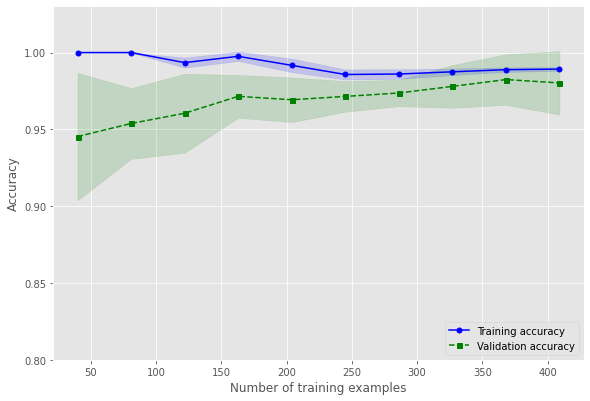
import matplotlib.pyplot as plt
from sklearn.model_selection import learning_curve

pipe_lr = make_pipeline(StandardScaler(),
                        LogisticRegression(penalty='l2',
                                           random_state=1,
                                           solver='lbfgs',
                                           max_iter=10000))

train_sizes, train_scores, test_scores = learning_curve(estimator=pipe_lr,
                                                        X=X_train,
                                                        y=y_train,
                                                        train_sizes=np.linspace(0.1, 1.0, 10),
                                                        cv=10,
                                                        n_jobs=1)
train_mean = np.mean(train_scores, axis=1)
train_std = np.std(train_scores, axis=1)
test_mean = np.mean(test_scores, axis=1)
test_std = np.std(test_scores, axis=1)

plt.style.use('ggplot')
plt.plot(train_sizes, train_mean,
         color='blue', marker='o',
         markersize=5, label='Training accuracy')

plt.fill_between(train_sizes,
                 train_mean + train_std,
                 train_mean - train_std,
                 alpha=0.15, color='blue')

plt.plot(train_sizes, test_mean,
         color='green', linestyle='--',
         marker='s', markersize=5,
         label='Validation accuracy')

plt.fill_between(train_sizes,
                 test_mean + test_std,
                 test_mean - test_std,
                 alpha=0.15, color='green')
# plt.grid()
plt.xlabel('Number of training examples')
plt.ylabel('Accuracy')
plt.legend(loc='lower right')
plt.ylim([0.8, 1.03])
plt.show()